80%
of CISOs cite redundant compliance efforts caused by siloed workflows

Compliance without complexity — long-term retention and compliance reporting built into XDR and MDR.
Instead of running a separate SIEM alongside your detection and response stack, Next-Gen SIEM keeps compliance data in the console you already use — licensed by users and servers, not by the volume of data you keep.
Sophos Next-Gen SIEM Overview 3:48
Siloed workflows mean the same data gets collected twice, stored twice, and reported on twice.
of CISOs cite redundant compliance efforts caused by siloed workflows
of organizations report rising compliance complexity
of security operations centers have no plan for the data already in their SIEM
Sources: The CISO Society, 2025 State of Continuous Controls Monitoring Report; PwC, Global Compliance Survey 2025; SANS, 2025 SOC Survey.
SIEM stands for Security Information and Event Management. Four stages turn raw, scattered machine data into a warning a human can act on.
Gathers logs and activity notices from devices, programs, and cloud services across your environment — servers, firewalls, identity providers, and applications included.
Cleans and sorts different data types into a single, uniform format, so events from unrelated systems can be compared side by side.
Uses rules and analytics to connect separate small events into a larger warning sign of an attack that no single log would reveal on its own.
Sends prompt warnings to your security team when something looks wrong, and produces the evidence trail an auditor expects to see.
Compliance evidence is scattered across identity, email, network, firewall, backup, productivity, endpoint, and third-party tools — and it rarely stops at the sources a vendor supports out of the box. Next-Gen SIEM is built to reach the rest.
Starts from the integration catalog already available to XDR customers, covering the mainstream endpoint, network, firewall, identity, email, cloud, backup, and productivity sources.
AI parsers read and normalize raw data from legacy systems, regional tools, and internally built applications — without your team writing and maintaining custom parsing code.
Threat-relevant telemetry and compliance-focused telemetry land in the same store, so an investigation and an audit query run against one set of records.
Long data retention cycles are often the reason a SIEM is required in the first place. Sophos Next-Gen SIEM includes 13 months of retention as standard, and it can be extended when a regulation, contract, or insurer asks for more.
Choose the retention period that fits the standard you report against, rather than rebuilding your logging strategy around a fixed limit — and because pricing is based on users and servers, a longer window does not turn into an unpredictable ingestion bill.
months included as standard
years maximum retention
Extend beyond the standard 13 months to 3, 5, 7, or 10 years.
Retention is usually bought to satisfy a regulation. Once the data is there and queryable in the same place your analysts work, it also answers the questions that decide how an investigation goes.
Years of retained telemetry let an analyst check current indicators against the full history of your environment, rather than against the last few weeks of it.
Knowing when an identity, host, or process was first seen separates activity that is merely unfamiliar from activity that arrived alongside the intrusion.
Long-run patterns across the estate show where risk and activity concentrate, so hardening and remediation effort goes where the record says it is needed.
Keep the full historical record centralized so audits and reporting draw on one source, rather than reassembling evidence from separate systems each cycle. Sophos Next-Gen SIEM helps meet the requirements of the major frameworks below.
Expects demonstrable monitoring and logging controls, evidenced at certification and again at every surveillance audit.
Requires log collection across the cardholder data environment, retained long enough for assessors to review the history.
Calls for audit trails over access to systems holding protected health information, held across multi-year review cycles.
Depends on records that support breach investigation and notification timelines, plus evidence of the measures in place.
Rests on continuous monitoring evidence for the security, availability, and confidentiality trust services criteria.
Beyond external frameworks, the same retained record evidences your own acceptable-use, access, and change-control policies — including the ones a customer contract or insurer asks you to demonstrate.
Each dashboard serves two audiences at once — an auditor who needs evidence that a control actually operated, and a security leader who needs to see where coverage is thin. They report on posture and control coverage, not just a count of incidents.
Whichever framework you report against, a dashboard draws on the activity already held in the retained record.
What changes for the team running security operations and compliance day to day.
One unified system supports both security operations and compliance, eliminating fragmented workflows and separate consoles.
Extend beyond 500+ XDR integrations to bring in the unique data needed to meet your regulatory requirements.
Threat-relevant and compliance-focused telemetry combine to build full historical context, enriching investigations with deeper insight.
Retain up to 10 years of data with pricing based on users and servers, reducing the cost and complexity of traditional SIEM models.
Sophos Next-Gen SIEM turns the data you retain for compliance into a security advantage. As part of the AI-native cybersecurity defense system powering XDR and MDR, every signal contributes to detection, investigation, and response. No separate console. No separate workflows. One unified context lake for better outcomes across security and compliance.
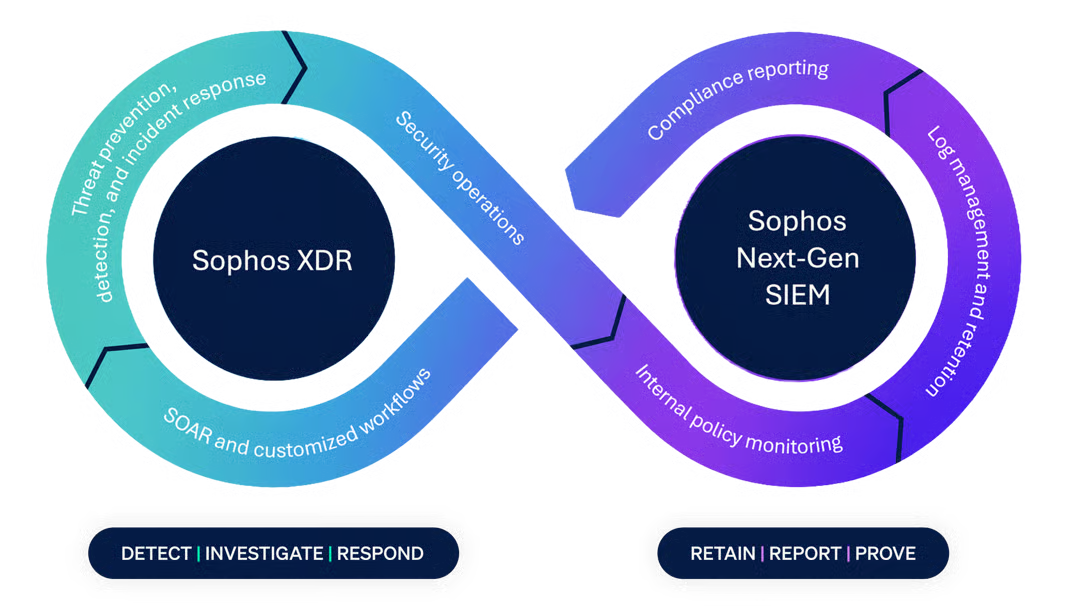
Sits in the same platform as your endpoint, firewall, email, and cloud protection, so log analysis lives next to the controls that act on it.
Widens what your existing XDR deployment collects and how long it is kept, without changing where your analysts already work.
MDR analysts investigate against the same unified data layer, so the sources you ingest for compliance also deepen managed threat hunting — drawing on intelligence from 625,000+ defended organizations and 380,000+ MDR investigations a year.
Next-Gen SIEM is aimed at organizations whose retention obligations outlast a standard detection window.
Organizations that have to produce log evidence years after the fact, not weeks.
Teams that need retention and reporting without taking on the cost and complexity of a traditional SIEM.
Financial services, healthcare, and government, where audit scope and retention periods are set externally.
Partners delivering scalable, premium security operations and compliance services to their own customers.
Sophos Next-Gen SIEM is licensed as an optional add-on to XDR or Sophos MDR. Pricing is based on your user and server counts and the retention period you select — not on how many gigabytes you ingest.
A per-user and per-server model, so the license scales with the size of your organization rather than the chattiness of your log sources.
No per-gigabyte charges and no data-volume penalties, which removes the pressure to filter out logs purely to control cost.
Start at the standard 13 months and extend to 3, 5, 7, or 10 years to match the standard you report against.
Next-Gen SIEM works alongside the rest of the Sophos Fusion portfolio.
The AI-native cybersecurity defense system that unifies management across your Sophos products.
Learn moreExtended detection and response across endpoints, network, email, cloud, and identity.
Learn more24/7 managed threat detection and response, delivered by the Sophos operations team.
Learn moreExtended storage for the detection data your investigations and audits depend on.
Learn moreTell us which systems you need to collect from, which frameworks you report against, and how long you have to keep the data. We will size Sophos Next-Gen SIEM around those requirements.
Contact Us TodayPricing Notes: